
 Written by
Construction barriers have been scattered across campus at a higher-than-average frequency over the past few years, and the results of this are starting to be unveiled to students. From the brand new buildings going up at Science Central to the renewal of some of the University’s oldest buildings, campus is changing fast, and there are several more projects in the pipeline.
Recent months have seen the Urban Sciences Building, the Boiler House and the Marjorie Robinson Library Rooms open to students, and these are soon to be joined by a Learning and Teaching Centre, an expanded Sports Centre and Black Horse House. This latter building is a converted office building located next to the Marjorie Robinson Library Rooms and will house some of the University’s support services, as part of a wider effort to relocate professional and administrative departments out of academic buildings.
The Research Beehive which has occupied a large part of the Old Library Building for more than a decade is set to be moved elsewhere, while IT Support will relocate from Claremont Tower to Black Horse House.
With student numbers seeing a consistent rise the University is experiencing increase pressure on teaching space, and there is only so much the Estate Support Service can do to use space more efficiently. With the main campus already at capacity new buildings are currently popping up further afield, with Science Central the most notable example of this.
-
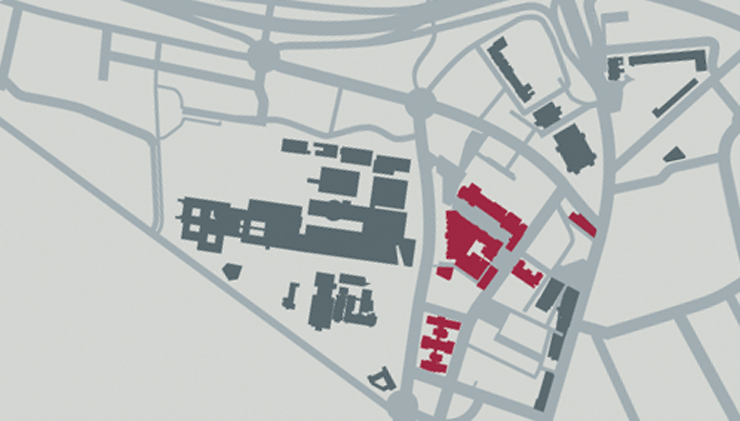
- The campus through time: although the University can trace its roots way back to 1834, the first development on the current campus was the Armstrong Building, which was built in phases between 1888 and 1906. Several other redbrick buildings soon appeared to complete the quadrangle, with Newcastle’s famous arches acting as its entryway. The fledgling institution also took over several nearby houses to convert to extra teaching space. The Students’ Union building was built in 1925 thanks to an anonymous donation, now believed to be from Cecil Cochrane, the chairman of the what was then known as Armstrong College. In 1934 Armstrong College and the College of Medicine, both colleges of Durham University, were combined to form King’s College, and five years later the medical school relocated from what is now Northumbria University’s Sutherland Building into the purpose-built King George VI Building. By the outbreak of the Second World War King’s College comprised a major part of Durham University and had colonised a sizeable area of land in the centre of Newcastle. Images: Mark Sleightholm
-
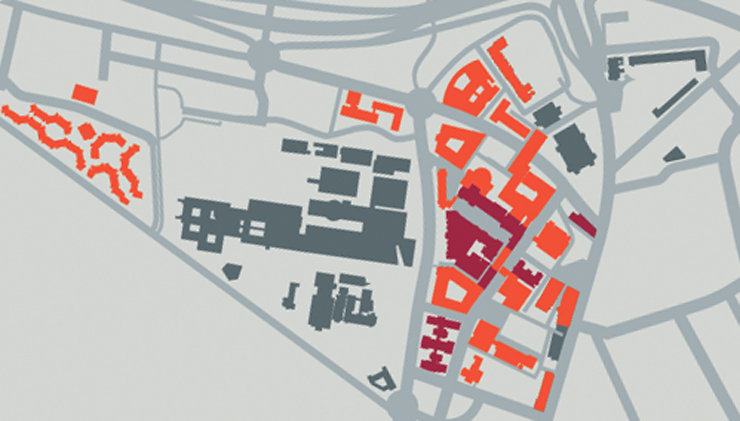
- After the War King’s College expanded rapidly, thanks to a series of compulsory purchase orders from Newcastle City Council. Much of this expansion came from buying up existing buildings, such as the Bruce Building, the Grand Hotel and the Grand Assembly Rooms along Percy Street. The Bedson Building opened its doors in 1949, followed by the Percy Building nine years later. More controversially, the University demolished most of the Georgian terrace of buildings known as Eldon Place to make space for an extension to the then-library building (now the Courtyard Cafe), Merz Court and the Claremont Tower/Bridge and Daysh Building behemoth. The Courier of the time protested against the demolition of the “unassuming yet dignified houses” but they were knocked down nonetheless, except for the final few buildings which now house Quilliam Brothers and the Security Control Centre. In 1963 the college finally achieved independence from Durham and became the University of Newcastle upon Tyne. A much-celebrated extension dramatically increased the capacity of the Students’ Union, while the University theatre and the opening of a Physical Education Centre in the Grand Assembly Rooms added to the non-academic offering on campus. By way of accommodation, Castle Leazes, Ricky Road and Henderson Hall’s New Hall were all added at this time.
-
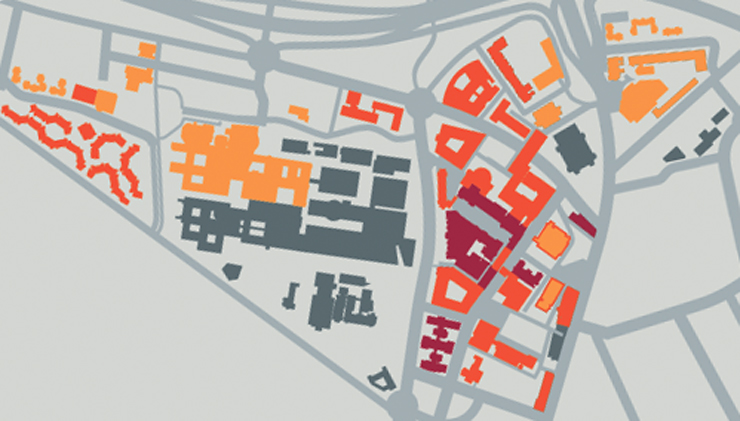
- The post-war building boom slowed down in the 1970s, but the campus continued to take over more and more of Newcastle city centre. A further extension to the Students’ Union building saw a large underground events space added, while the at-capacity Physical Education Centre next door was supplemented by squash courts and a sports hall opposite Ricky Road. The library had been extended several times over the decades, but by the early 1980s was once again too small to meet the needs of the growing student population. A brand new building was built on the other side of Barras Bridge, opening in 1982 and renamed the Robinson Library in 1989 in honour of local bookseller Philip Robinson. Even this was soon outstripped by demand, and a major extension was required in 1996. By this point Windsor Terrace had also been colonised by the University, with politics and law taking up the Georgian houses on one side while new accommodation was built on the other side. In 1984 the Medical School moved into a new building next to the RVI, while the University theatre underwent a major refurbishment in the mid-2000s, reopening as Northern Stage in 2006. The ground-breakingly eco-friendly Devonshire Building opened in 2004.
-
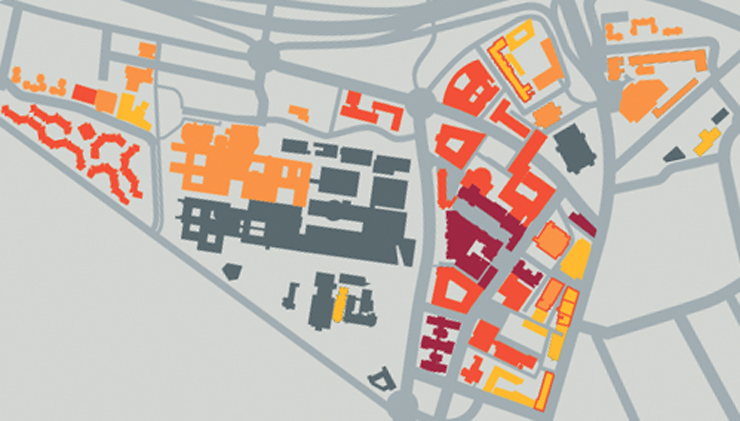
- A new Vice-Chancellor, Chris Brink, took up office in 2007 and made it his mission to make the campus greener. Car parks were torn up and softer landscaping introduced, with extensive planting across campus. As part of an attempt to generate a more specifically ‘campus’ feel, the Museum of Antiquities building was demolished to make way for a Student Form between the Students’ Union, Armstrong Building and the Arches. The Robinson Library, Student’s Union and Armstrong Building all underwent major refurbishment programmes, while the Law School was extended in 2010. Also in 2010 the University’s administration and student support departments moved from converted houses on Kensington Terrace to the brand new King’s Gate building, with their vacated buildings being converted into student accommodation. Newcastle University entered into a partnership with INTO to offer foundation courses to international students, with a specialist INTO building and associated accommodation blocks opening from 2010, while another glass-fronted building offered a new home for the Business School to the west of campus. Several of the buildings bought in the 1940s had lain empty for several years, but in the early 2010s the Bruce Building and Grand Hotel became postgrad accommodation while Quilliam Brothers opened in the Claremont Building.
-
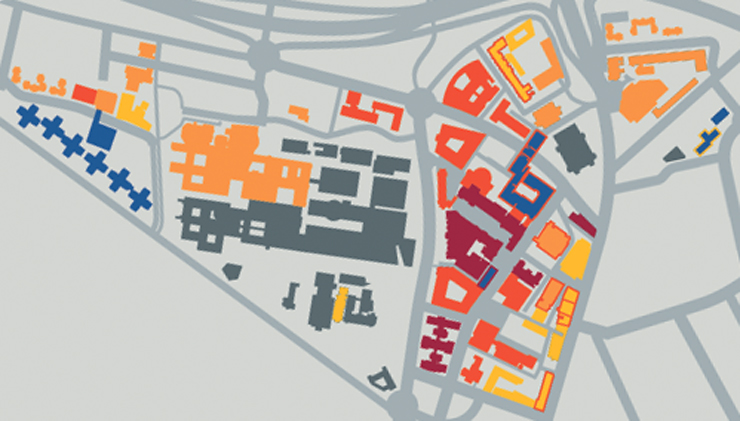
- The current wave of developments marks a further expansion of campus beyond its traditional boundaries. With the library once again at full capacity, a nearby office building was bought by the University in 2014, opening as the Marjorie Robinson Library Rooms in January 2016 and undergoing a phased redevelopment. The next-door building, Black Horse House, has also been purchased to house professional support services. The Student Forum has been complemented by a newly-redeveloped Boiler House and a new Armstrong Quad, featuring a statue of Martin Luther King to commemorate the honorary degree he received from the University in 1967. The biggest change to campus in the 2010s was the addition of Science Central. The site of a former brewery complex was bought by the University in 2005 and after a lengthy planning process the first building on site, the Core, opened in 2012. Science Central is a partnership between the University and Newcastle City Council, where industry, teaching and research will take place in close proximity to each other. The first major University presence on site came with the opening of the Urban Sciences Building in 2017, set to be complemented by the Learning and Teaching Centre in 2019. Meanwhile Ricky Road was demolished in 2016 to make way for a new accommodation site and a substantial extension to the Sports Centre.
Some of the estate projects are smaller in scale but still significant. Scaffolding has been up around King’s Gate for several months now, because a problem with the stone cladding is being rectified by the contractors responsible for the original construction in 2010, at no extra cost to the University. The plan is to re-clad the entire building one elevation at a time.
The Armstrong Building is currently in phase five of its major refurbishment project, which has been underway for over five years now. Last week the circular staircase finally reopened to students, while work is currently underway to replace all of the building’s 2,400 windows. This should be finished by September and will make the Grade II listed building considerably more energy efficient.
Indeed, sustainability is a key theme within the Estate Support Service’s strategy. As well as introducing as many double-glazed windows as possible to University buildings, they are hoping to replace fluorescent lighting with LED lights over the next three years, that will save electricity and emit a brighter light.
A new entrance to the Bedson Building on King’s Road now provides level access to the building as well as “turning the building round” to face into campus instead of away from it.
A similar process has taken place in the neighbouring King George VI building, while the Armstrong Quad has made the campus-facing entrance to the Armstrong Building more visitor-friendly.
[pullquote]Over the next three years the University hopes to completely refurbish the entire Claremont Tower, Claremont Bridge and Daysh Building complex, with the Boiler House being used as temporary teaching space[/pullquote]
Whereas many of the older buildings on campus have relatively restricted access, accessibility is at the forefront of each refurbishment project. Wherever possible steps are being replaced by gentle slopes or level access and navigation signs are being made as clear and straightforward as possible.
Consideration is also starting to be given to using building design to help students with mental health difficulties. The Urban Sciences Building, which opened in August 2017, includes two quiet rooms that can be used as prayer spaces or areas for students to take private breaks.
The Estate Support Service now has an accessibility group who consider the needs of all of a building’s potential users and aim to make Newcastle’s campus as accessible as possible.
As part of the Courier’s special report into campus developments, we look at the changes you can expect over the coming months and ask what this all means for the future of our campus
Another recurring theme within the redevelopments currently underway is to make buildings more suitable for alternative methods of teaching and learning. For example, The Herschel Building is now home to the innovative Learning Lab, where PCs are able to link to each other to enable group work and multi-layered teaching.
In particular, the Estate Support Service want to include more “problem based learning space” on campus, with the emphasis on group work and student-led learning rather than, or at least alongside, more traditional methods such as lectures and seminars.
The new Learning and Teaching Centre at Science Central will include a 750-seat lecture theatre. To put this in perspective, the Curtis Auditorium in the Herschel Building can seat 360 people. The massive lecture theatre will spend most of its time subdivided into two theatres, but the option to combine these into such a large space will provide new opportunities for teaching and for University events.
Rather than hosting particular academic departments like the Urban Sciences Building next door, the Learning and Teaching Centre will be used by many departments. In particular, though, it will be utilized by the Business School, who currently need to use buildings on the main campus for teaching, meaning that business students need to regularly make the 15-minute walk to and from lectures.

The reception area of the proposed Learning and Teaching Centre. Image: Newcastle University
One possible concern with the new developments at Science Central is their distance away from the main campus, particularly considering the addition of the Marjorie Robinson Library Rooms in the opposite direction. For this reason the new buildings contain more facilities such as cafés and study spaces than may be expected, while the Estates team are putting considerable effort into increasing the ‘campus’ feel of the University.
A key feature of this renewed atmosphere is the development of the Student Forum at the heart of the redbrick centre of campus. Formerly the site of the Museum of Antiquities, now located in the Great North Museum, this building was demolished in 2012 to make way for a pedestrianised area with sculptures, seating and planters.
Since last year this has been further developed by the changes to the Armstrong Quad, which provide more visitor-friendly access from King’s Hall to the newly re-opened Boiler House. The Boiler House will be used for University and Union events, with graduation receptions a particularly keen future tenant given the close proximity to King’s Hall.
However, over the next few years the Boiler House may be better known to students as a teaching space. With the School of Computing moving out of Claremont Tower, its home of 50 years, last July into the Urban Sciences Building, several floors of the Tower are now largely empty, although teaching rooms have quickly been snapped up by over-capacity departments such as Geography.
Over the next three years the University hopes to completely refurbish the entire Claremont Tower, Claremont Bridge and Daysh Building complex. This will include re-cladding the entire building, overhauling the creaking infrastructure and making the connections between the three buildings easier to find. This will provide additional teaching space to HaSS departments that are rapidly running out of room. While this project is taking place, however, every available teaching space will need to be used by departments such as Geography and Sociology that currently call the complex home.
Another occupant of the Urban Sciences Building is Open Lab, which formerly called the top two floors of the Marjorie Robinson Library Rooms its home. These floors were then opened to students while levels one and two were re-refurbished; floors three and four will soon follow suit.
The back-and-forth nature of the Marjorie Robinson redevelopment demonstrates the constraints facing the Estate Support Service. With all buildings already at full capacity, closing one requires a considerable reorganisation of teaching space. The Learning and Teaching Centre will free up space for developments elsewhere on campus, but it is a constant process of reshuffling departments to ensure campus continues to improve and meet the needs of its staff and students.
Timeline of developments – what’s happening where, and when
Analysis – what does the future hold for our campus?
Park View progress – the new accommodation to replace Ricky Road
Sporting changes – both the Sports Centre and Cochrane Park are due an upgrade
Armstrong Building Boiler House building campus Claremont Tower development Science Central Urban Sciences Building
Last modified: 27th March 2018


Rent Strike‽
by Eve Brennan• 13th November 2020
Students across the country, in Manchester, Bristol and Glasgow, to name a few, are participating in rent strikes to protest their continuing payment of rent and tuition fees...